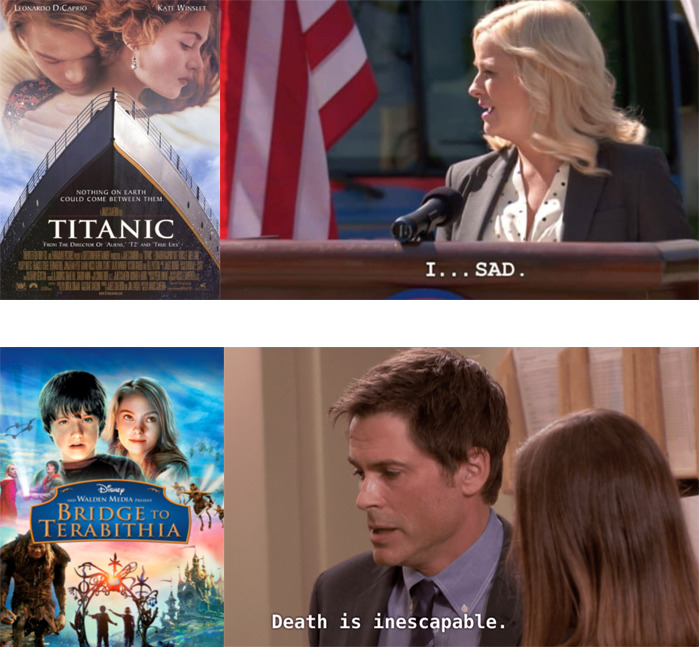
yeah the movie titanic was sad but i can watch it now and not even blink twice. bridge to terabithia on the other hand? i saw that movie one (1) time as a kid and vowed immediately afterwords to never ever watch it again. once was enough for that movie
“You have to write the book that wants to be written. And if the book will be too difficult for grown-ups, then you write it for children.”
back when i had to do creative writing assignments in English class i did one on the bubonic plague and it went down fantastic bc old people love boring shit like that just write a story about a tragedy like the plague or a war and the doctors realising that they’re a symbol of death instead of hope the board will eat that shit right up there’s your life pro tip for the night kids
Decades earlier, another Sears executive engaged in activism of a different sort. Julius Rosenwald began promoting civil rights causes while he was still president of Sears, before he became its chairman in 1924, leading some to call him the “first social justice philanthropist.” He helped fund fellowships for black artists and academics, including W.E.B. Du Bois and James Baldwin. He worked with Booker T. Washington to open more than 5,300 schools for black children in the Jim Crow South. Some of them were burned down by the Ku Klux Klan.
There’s also this article titled “A Peculiar Alliance: Julius Rosenwald,
the YMCA, and African-Americans,
1910-1933″ from American Jewish Archives that touches on this further. Here’s an excerpt:
“The alliance between Rosenwald, the YMCA, and African-Americans
seems rather peculiar at first glance. Why would a Jew support
the establishment of Christian facilities for African-Americans? David
Levering Lewis, who examined the collaboration between AfricanAmericans
and Jews during the 1910s and 1920s~ has suggested that
some of the wealthy Jews who aided African-Americans had ulterior
motives. According to Lewis, they reasoned that their assistance to
the African-American struggle for racial advancement would spare
Jews “some of the necessity of directly rebutting anti-Semitic stereotypes,”
for white America would perforce conclude that if “blacks
could make good citizens…all other groups [including Jews] could
make better ones.” Yet Lewis’s highly interpretive study offers no
evidence to support this contention.
Julius Rosenwald certainly never said that his support of AfricanAmerican
causes was stimulated by a desire to refute anti-Semitic
stereotypes. On the contrary, Rosenwald claimed that he was motivated
by sympathy for the victims of discrimination. Having experienced
the indignity of anti-Semitism, he felt compassion for those
who suffered from racism.



















 sky's stuff