Love how the official Splatoon lore is just like “this song slaps so fucking hard that even our mortal enemies changed their ways and came to live among us in peace after hearing it”
some middle aged white dude who has never had a problem with his perfectly sculpted body in his life: Does replacing our flesh with metal and circuits… disconnect us from humanity? When you replace man with machine… how long does the soul stay connected?
literally anyone who has had a limiting physical condition, interacted with prosthetics or assistance devices: You really don’t understand the ‘Punk’ of Cyberpunk, do you?
Something a lot of early cyberpunk’s modern imitators don’t seem to grasp is that the reason early cyberpunk treats cybernetic modification with suspicion is because those modifications are often performed against the recipients’ will at the behest of state and corporate interests. It’s an explicit metaphor for the commodification of bodily autonomy under capitalism – and it draws a direct line to contemporary abuses of the same. It’s not by accident that the first chromed-out street samurai to grace the pages of cyberpunk literature is a woman.
I like the OP’s post as well as the preceeding reply. Both make excellent points about cyberpunk and cyborgs.
So, fun fact for all of you history dorks, but you know that legend about Cleopatra being so rich and trashy that she would drink her wine with crushed up pearls in it?
Pearls are mostly Calcium Carbonate. When they mix with acids (such as those in wine) they produce carbon dioxide like little balls of fancy alkaseltzer.
What Im saying is, call Cleopatra a trashy hoe all you want, but she was the trashy hoe who invented instant champagne. Bitch was living in 3018 while everyone else was in 18
It is polyvalent in its applications; it serves to reform prisoners, but also to treat patients, to instruct schoolchildren, to confine the insane, to supervise workers, to put beggars and idlers to work. It is a type of location of bodies in space, of distribution of individuals in relation to one another, of hierarchical organization, of disposition of centres and channels of power, of definition of the instruments and modes of intervention of power, which can be implemented in hospitals, workshops, schools, prisons. Whenever one is dealing with a multiplicity of individuals on whom a task or a particular form of behaviour must be imposed, the panoptic schema may be used. It is – necessary modifications apart – applicable ‘to all establishments whatsoever, in which, within a space not too large to be covered or commanded by buildings, a number of persons are meant to be kept under inspection’ (Bentham, 40; although Bentham takes the penitentiary house as his prime example, it is because it has many different functions to fulfil – safe custody, confinement, solitude, forced labour and instruction).
In each of its applications, it makes it possible to perfect the exercise of power.
Prison guards patrolling the perimeter with guns just makes that comparison a WHOLE LOT MORE DIRECT
My favourite part about Foucault and the Panopticon theory in general is that it doesn’t just apply to institutions, it applies to the way we present ourselves as a whole. Kids try so hard to fit in with each other because the systems they live in teach them that someone is always watching, someone always knows everything they do and their lives will be ruined if they step a foot out of line; it’s useful in systems like schools and community centres that function around control, but it’s a severely fucked up way to live and a really fucked up way for kids and young adults to grow up thinking.
Like, slightly off tangent but that’s what I find fascinating about that in gender theory, both as someone who has studied it and as a Trans person; I found myself not only performing the gender I was assigned for everyone else, but I also perform my own gender sometimes to an extreme that would be uncomfortable if I had been born in the body I was supposed to be born in, specifically because “They” who watch are going to judge me and stop me from getting my shit done. I mean it’s not wrong, I’ve had some interesting conversations with people that boil down to “I don’t think you have a right to exist go to hell in a handbasket” but it’s always about being SEEN with me, being seen talking to me, etc etc. It’s all about public perception, and the idea that people are going to be punished for stepping out of the box society has created for them.
Once you’re aware of the theory it really helps you examine your own actions, and look at how communities, no matter how big or small, structure themselves around Panopticons as a basic operating system because we’ve fucked each other up that much.
I don’t think I’d ever recognized how directly surveillance and “protection” parallels the feeling of being in prison. And how literally privacy parallels freedom and liberty.
Major internet sites, big corporations in general, and conservative politicians are working to implement a panopticon dystopia in order to monitor, control, and use us for their own profit.
That’s the definition of life in prison. The prison-industrial complex seeks to expand its reach to all of us.
Don’t let them win.
It’s not just conservative politicians, but all wielders of the state apparatus who benefit from the expansion of surveillance as a means of control.
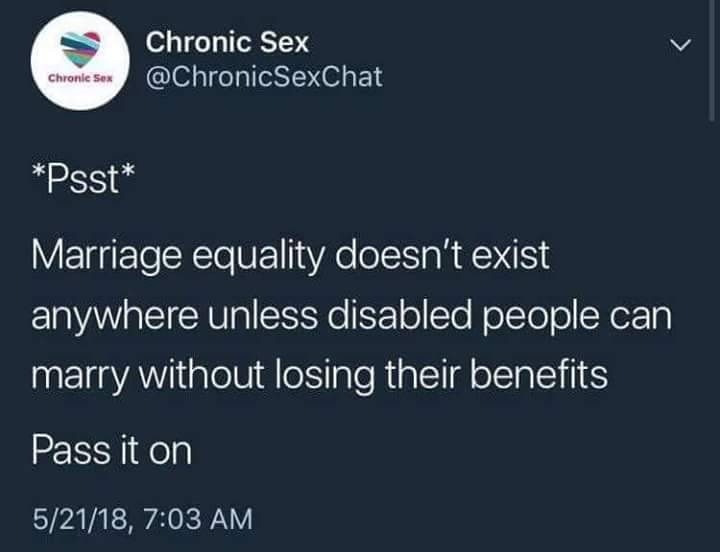
I’m all for fighting for marriage equality in the LGBT community. But we’re so focused on that no one knows about this problem.
W…wait Thats a thing????
Yep! The man I refer to as my husband? We aren’t actually married. We can’t be.
If I married him, the government would literally expect me to care for him and be his sole source of income. He would lose all of his benefits, including SSDI. Spouses are expected to share income and that effects ALL of his benefits, even his health insurance. We simply can’t afford to be married.
But it goes even further than that. If I were disabled, our incomes would STILL be combined, meaning BOTH of us would have our benefits cut.
For people reviving supplemental income, their benefits can be cut anywhere from 25% of their current income all the way down to 0%
In fact, one of the stipulations of receiving income under the adult disabled child program (which provides benefits for people who were disabled before age 22) is that they LITERALLY never be married.
I normally don’t link to blog posts as resources, but since social service resource sites like to dress this problem up and make it seem smaller than it really is, I’m gonna call it appropriate! Check it out!










 sky's stuff