Book!Hermione has an almost pathological fear of failure. She wants to accomplish everything perfectly and by herself, and remain in control all the time. Movie!Hermione is the perfection she wishes she could be.
Book!Ron has a huge inferiority complex. He worries that he has no real accomplishments or valuable skills, and that his friends don’t really like or need him. Movie!Ron is the failure he fears he could be.
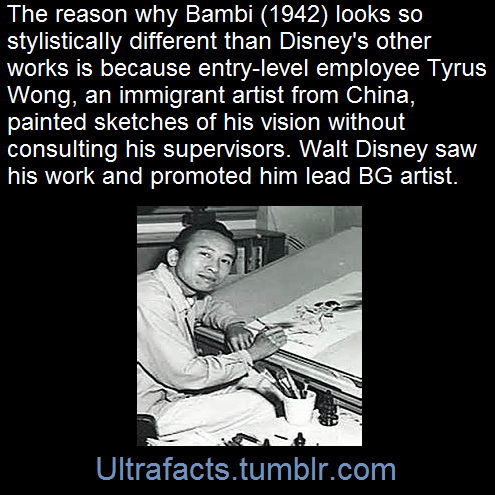
He was a young artist employed by the Disney studio, but tasked with the entry-level job of finishing off the work of the animators and crafting the “in-between” animations that completed the characters’ movements. Wong had learned that studio executives were creating a film from the new novel, Bambi, A Life in the Woods by Felix Salten. Tom says the young artist read the book and without consulting his supervisor, “took the script and painted some visual concepts to set the mood, color and the design.”
His sketches recalled the lush mountain and forest scenes of Sung dynasty landscape paintings. His initiative paid off. Walt Disney, who was looking for something new for the film, was captivated and personally directed that Wong be promoted. Today, top animators and illustrators revere Wong’s work. Children today are as enchanted by the misty, lyrical brushstrokes of Wong’s colorful nature scenes, inspired by his training at Otis College of Art and self-study of Sung Dynasty art
THIS GUY HELPED MAKE THE FILM THAT MADE ME WANT TO BE A FILMMAKER AND *HE IS STILL ALIVE*
AAAAAAAAAAAAAH
I met him at a gallery event a number of years ago and, UGH HE IS SO TALENTED AND SO KIND AND ENCOURAGING THERE IS A REASON WE ALL LOVE HIM. Also, my alma.
GUYS WTF IS THIS CRAZY TALENTED GUY- HE MAKES KITES TO WOW JUST WOW
click through the source link, the smithsonian article is pretty great.
Friendly reminder that Ciel is the same height as Nicki Minaj.
but she’s slicker than the guy with the thing on his eye
I’ve been on this godforsaken site for a long time and of all the things I’ve seen, Ciel Phantomhive and Nicki Minaj being compared is one of the strangest
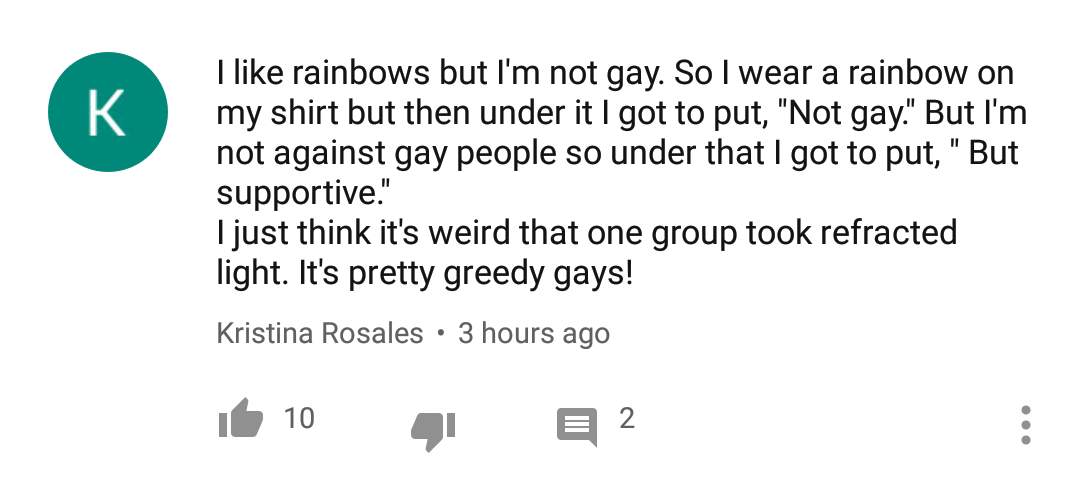
Reblog if you are a greedy gay hoarding refracted light all for your greedy gay self
I totally am, but also: I have a story. The time: 1995. The place: a small liberal arts college. We decided to participate in “denim day” which was a widespread event wherein on National Coming Out Day, you would wear denim to indicate SUPPORT FOR the LGBT community. Our support group made posters that were very, very clear about this. Wearing denim did not mean that you were coming out, it meant you supported anyone around you who might.
I have never seen so many suits and khakis IN MY LIFE. People who accidentally wore jeans went home and changed.
The community took it as a rebuke. We drew in closer to eachother, and felt unwelcome everywhere we thought we had friends before.
And I had people later tell me “You know I support you, just… I didn’t want anyone to think I was.” First off, I DON’T know you support me. Not if you refuse to, for one day, change nothing about your life to show it. Second off… why is that such a terrifying thought to you?
I remember before rainbows were a “gay thing”. They were everywhere. Church walls next to arks. School walls next to sunshine faces. People have VOLUNTARILY abandoned every other use. I have HEARD PEOPLE SAY they just couldn’t use rainbows anymore because people would think of “gay stuff.”
So I know this is a joke, and a stolen one at that, but you’ve done this to yourselves. If someone is so terrified of being perceived as queer that they will INSTANTLY abandon something they like if it has queer germs on it now or something, then they don’t deserve refracted light.
Maybe help us change the world into a place where being mistaken for queer would be just a thing to chuckle about and you can have refracted light back.
The LGBTQ+ community didn’t steal the rainbow. The straights abandoned it.
One of the most useful things I’ve learned about recovering from trauma is that my decisions need to be judged according to the incomplete information that was available to me at the time.
So, say I’m deciding whether to eat chicken at a restaurant. All evidence is that it’s a good idea. I’m hungry for chicken, and I usually feel good after eating it.
I eat the chicken, and I get food poisoning. The resulting illness causes me to fall short of responsibilities, and creates numerous problems for me and the people who depend on me.
What happened?
Trauma brain says: “This happened because I am Bad At Making Decisions. If I had made The Right Decision and not eaten chicken, everything would have been fine.”
Recovery brain says, “According to the information that was available to me, the chicken was unlikely to make me sick. Eating chicken was a Good Decision with Bad Consequences. This happened to me because I had incomplete information.”
The “trauma brain” response makes all decisions really hard, because each decision involves the prospect of being judged by a future self that has more information.
“Should I buy the $2 mouse pad or the $3 mouse pad? If I buy the cheaper one and it doesn’t work well, it will be my own fault for not buying a better quality one…”
(Then I might end up paying myself $1-per-hour to agonize over which mouse pad to buy, which is probably an ACTUAL unwise course of action.)
But if I foster the “recovery brain” response, I can start to trust that my future self will judge my decisions kindly.
“If I buy the cheap mouse pad and it doesn’t work, then I only gambled $2 on it. If I buy the $3 one and even it doesn’t work, then I’ll have more closely guessed how much I need to pay for a mousepad of sufficient quality.”
And then later when the mousepad doesn’t work: “Well, that didn’t work. At least I made a decision. The outcome has given me more information about the options available to me going forward.”
(Meta level: Decisions you made prior to reading this post about how to treat yourself were probably good given the information you had access to about trauma and recovery!)
tl;dr: Bad results are not always evidence of bad decisions. Give yourself the benefit of the doubt about why you do what you do.






 sky's stuff