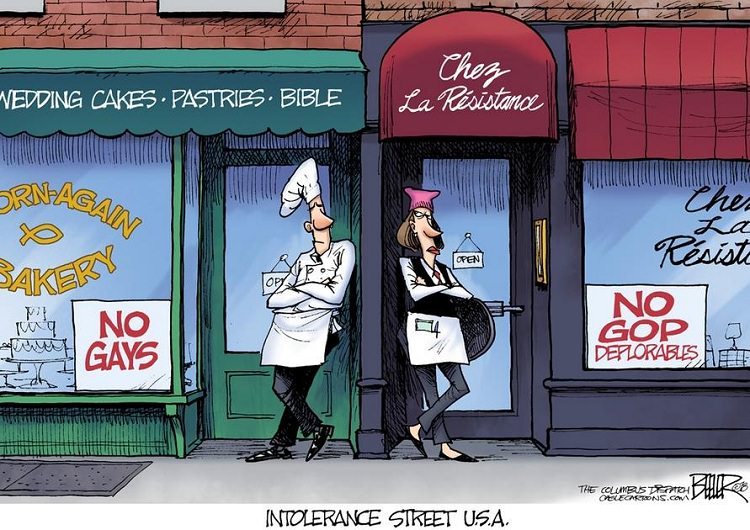
conservatives are intolerant of who you are; progressives are intolerant of what you do. a good cartoon.
Why is that bakery selling “Bible”
Just one Bible? Offered at a totally unrelated business? I’m so confused
I feel bad for OP because they probably just wanted to post their little post and get their handful of notes for it, but this is such a perfect piece of rhetoric to dissect that I’m going to forcibly make it into a teaching tool, and they’re just going to have to deal with that. In this case, OP and the cartoonist are confusing judgment with prejudice. It’s likely to be simple ignorance on OP’s part, but it’s a deliberate rhetorical choice that the cartoonist made to create this piece of propaganda.
OP and the cartoonist are both conflating judgment/prejudice and equating them, stating that they are both equally bad forms of “intolerance”.
Society usually suggests it isfair and reasonable to “judge” people differently based on their behavior choices. This is the underpinning of many institutions, such as education, justice, barter, and (generally) employment. If people behave badly, this rule says, then they are supposed to receive fewer rewards and opportunities, until they correct their bad behavior or are forcibly deprived of their rights.
This judgment is also how many people behave at a personal level, as it allows personal relationships to function, and behavioral choices can be made based on previously agreed rules about what good behavior looks like. This is generally considered to be an acceptable way to run a society; if someone lies, steals, cheats, or attacks others, then they have behaved badly, and the society judges and treats them accordingly. In this manner, society is kept in a relatively stable form. It would be very hard to demolish this system, and I’m not sure what a sustainable alternative would be.
This is why “Judgment” is considered to be logical and reasonable, while “prejudice” (quite literally pre-judgment) is considered to be illogical and unreasonable. That’s why having “good judgement” means being able to make good decisions, while there is no such thing as “good prejudice”. Judgement makes the laws; prejudice, when used to discriminate against people, is often illegal. They are not the same thing.
The idea that bad behavior should
not be tolerated is as old as the Code of Hammurabi. It’s the
foundation of multiple religious texts. It’s what little children are taught from the cradle all around the world, and is the foundation of most Heavens and Hells. It is usually called
something like “judgment”, “justice,” “consequences” or “discipline” …
not “intolerance.” But if it is called intolerance, then it is certainly correct that bad behavior is not supposed to be tolerated.
According to the OP and cartoonist, the animal kingdom is surprisingly left-wing, with social animals being particularly intolerant of “what people do” when those actions unfairly deprive others of resources. Chimpanzees and ravens can be taught to play cooperative games by scientists – and, famously, social animals don’t want to play with animals that reveal themselves as cheaters or thieves. Animals that behave unfairly during cooperative games quickly lose the trust of other animals, and their fellows will refuse to play cooperative games with them. To me, as an evolutionary biologist, it’s amazing to think that concepts like “accountability” are meaningful to animals.
If you genuinely believe that this is a bad thing – that intolerance of “what [people] do” is just as bad as intolerance of “what [people] are,” then my goodness! Equating those would be a complete overhaul of the most basic tenets of human society, spirituality and morality. I really would be interested in knowing what the alternative would be, and how a society could be run if it genuinely considered these things to be equal. I would genuinely like to know how far this belief goes when questioned, and how people manage to reconcile it with their position in society.
So what’s the idea behind the rhetoric in the OP? Well, apart from confusing and misinforming people, it hopes to convince them that judgment and prejudice are equally bad. This will be useful because if people believe this, it can be used to convince them that they must not punish social-rule-breakers (“You are obligated to serve customers who behave badly”) as well as diminishing the role of civil rights. The idea that “both sides are equally bad” is a commonly sown one in this decade, as it hopes to create a majority of disillusioned, docile people who won’t vote and don’t believe in change, leaving the playing field to be controlled by energetic extremists.
But in an insidious way, it also attacks that idea of “accountability,” that nebulous nation-building concept that even crows hold dear. Personally, that’s not what I like to see in my opinion leaders – it’s most commonly promoted by people who behave badly.
OP is right about cartoon quintessentially full of shit. Thank you @elodieunderglass for that excellent demonstration of exactly why and how.
ETA edited because I completely misread initially – the OP is the initial comment, not the cartoon!!!!!!
Your professor will not be happy with you if he says the Stanford Prison Experiment shows human nature and you say it shows the nature of white middle class college-aged boys.
Like he will not be happy at all.
For real though. That experiment. Scary shit.
This reminds me of a discussion that I read once which said Lord of the Flies would have turned out a hell of a lot differently if it was a private school of young girls (who are expected to be responsible and selfless instead), or a public school where the children weren’t all from an inherently entitled, emotionally stunted social class (studies have shown that people in lower socioeconomic classes show more compassion for others).
Or that the same premise with children raised in a different culture than the toxic and opressive British Empire and it’s emphasis on social hierarchy and personal wealth and status.
And that what we perceive as the unchangable truth deep inside humanity because of things like Lord of the Flies and the Stanford Prison Experiment, is just the base truths about what happens when you remove any accountabilty controlling one social group with an overwhelming sense of entitlement and an inability to feel compassion.
I will always reblog this.
I just wanna say that the Lord of the Flies was explicitly written about high-class private school boys to make this exact point. Golding wrote Lord of the Flies partially to refute an earlier novel about this same subject: The Coral Island by
R.M. Ballantyne. Golding thought it was absolutely absurd that a bunch of privileged little shits would set up some sort of utopia, so his book shows them NOT doing that.
This is also generally true about most psychological experiments.
There’s an experiment called “The Ultimatum Game”. It goes something like this.
Subject A is given an amount of money (Say, $100).
Subject A must offer Subject B some percentage of that money.
If Subject B accepts Subject A’s offer, both get the agreed upon amount of money. If Subject B refuses, no one gets any money.
The most common result was believed to be that people favored 50/50 splits. Anything too low was rejected; people wanted fairness. This was believed to be universal.
And then a researcher went to Peru to do the experiment with members of the indigenous Machiguenga population, and was baffled to find that the results were totally different.
Because, to the Machiguenga, refusing any amount of free money (even an unfair amount) was considered crazy.
So the researcher took his work on the road (to 14 other ‘small scale’ societies and tribes) , and to his shock found the results varied wildly depending on where the test was done.
In fact, the “universal” result? Was an outlier.
And that’s the problem. 96% percent of test subjects for psychological research come from 12% of the population. Stuff that we consider to be universal facts of human nature… even things like optical illusions, just… aren’t.
You can read an article about it here. But the crux of it is that psychology is plagued with confirmation bias, and people are shaped more by their environment than we realize.
Just a btw of your professor tried to say the Stanford Prison experiment was about human nature, they’re a bad professor. Every single instance I’ve see of in in my textbooks over the last two years have had a disclaimer about the bias.
i mean a realistic portrayal of lesbianism would be like…realize you’re gay in your teens but don’t date throughout all of high school…first relationship at age 18-21 and you have some kind of issue around sex/touch…like just based on the lesbians I know…i genuinely know maybe two lesbians who dated in high school. Like the coming of age drama plotline is so out of touch with the experiences of virtually every lesbian I know
if a teenager is at your door and they are wearing a costume!! please give them candy!! they are still in it for the halloween spirit and it honestly no different from a little kid in a costume. they are just as excited and happy as all the other lil tykes and dont you dare tell them they are “too old for trick-or-treating” because that will literally break their hearts and that’s not cool.
Its getting close to Halloween again so I just thought I’d reblog this again
And if “don’t be rude to teenagers over a stupid jawbreaker” isn’t enough for you, consider
You can’t tell how old a kid is just by looking. I’ve known multiple 5th graders who were taller than I am, and I’m 25 years old. With their faces hidden by masks, you won’t be able to tell they’re elementary schoolers, but they still are.
Lots of older siblings are expected to take their younger siblings trick-or-treating, and they only get paid in candy.
You don’t know if that teenager is developmentally disabled.
You don’t know if that teenager spent most of their childhood in a hospital or sick and has never had the traditional trick-or-treat experience before.
You don’t know if this is that teenager’s first Halloween in America, and they just want to experience a piece of American culture.
You don’t know if that teenager ever gets candy any other day of the year.
You don’t know if that teenager has eaten anything at all today.
And those are just things I can think of off the top of my head.
and even if it is just a bored 16/17 year old out trying to see what free shit they can get. is it really gonna kill you to give them a fun sized milky way from the multipack you bought at poundland? That thing didn’t even cost you 5p, just give the kid the sugar, say “nice costume”, and let it go.
There are worse things a teenager could be doing on Halloween instead of trick-or-treating.



 sky's stuff