I read a lot of scripts. A lot. From professionals to aspiring writers to complete newbies. Features and pilots. Specs and treatments.
And 8 times out of 10 the fan fic that I’ve read over the last, oh, 15 years is leagues better than this stuff. It’s more inspired. It’s more compelling. It’s genre bending and creative and heartfelt. It’s well-paced and intense and funny and sexy and meaningful. It’s smart and thoughtful and good. It’s novel-quality. Better than, sometimes.
Rare is the script I don’t want to put down, but how often have we stayed up until 3am to get to the last chapter of a 100k fic? And it’s not even a fan fic author’s day job. This is what they do on the side. In their spare time. For free.
So my point is, fan fic authors, you’re good. You’re good writers and great storytellers. I know it doesn’t always feel like it, especially if you’re one of the authors who’s not a BNF and doesn’t get the notes/hits that a few do. And because some people still view fic as “not real writing.” You guys know the shit that gets made into movies. You’re better than that. So be better than that. If writing is what you think want to do, then just know you’re already doing it. You’ve already started.
And you’re more talented than you might think.
To all of my writer friends. This is so fucking true. ❤
To those who write, and those who read – this one’s for you.
I hope that all lesbians who once thought they were bi know that they aren’t contributing to the “bi is just a stepping stone to gay” stereotype. That stereotype was made up by straight people who refused to try to understand bisexuality. I also hope that all bi women who once thought they were lesbians know that they aren’t contributing to the “all lesbians must secretly like men” stereotype. Again, this was made up by straight people who refuse to try to understand lesbians. It’s not anyone’s responsibility in their journey of self discovery to dismantle every harmful stereotype along the way; sometimes you’re just figuring yourself out and get mixed up along the way and that’s okay. We have each other to support each other as wlw regardless of whether or not we got confused down the line at some point.
I needed this
I’m real tired and sick and my brain decided to substitute the word ‘aliens’ for ‘lesbians’ throughout this post and I have just been sitting her bewildered but generally supportive
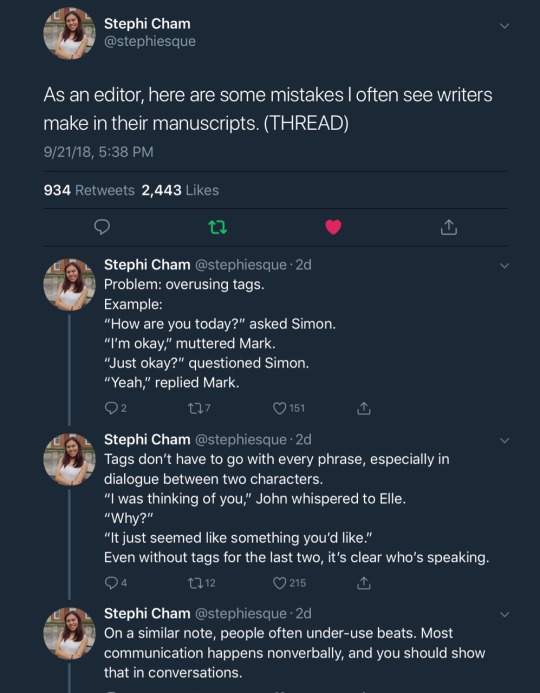
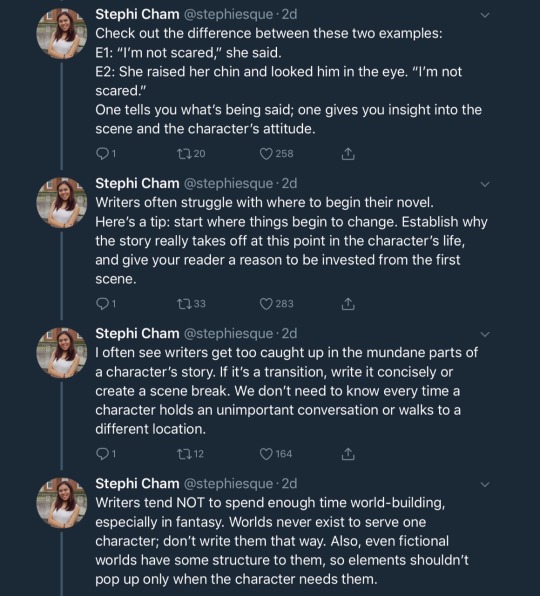
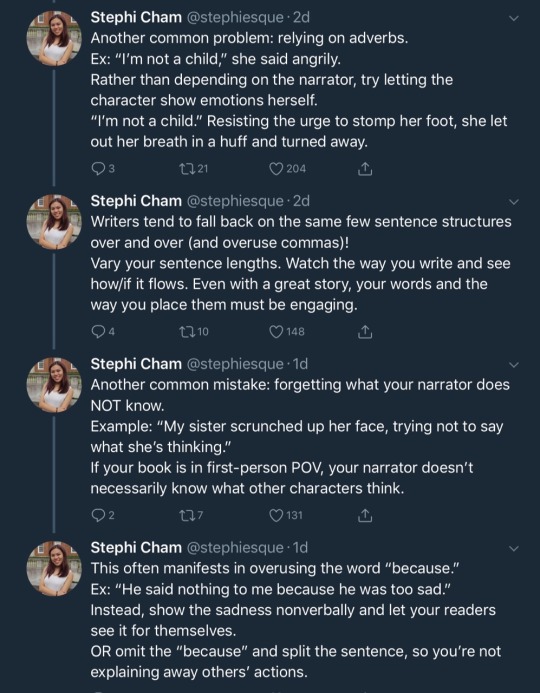
This. This is good fiction writing advice. I really appreciate how it was formatted as “this is a common problem, here is a solution to try in your own work” and not “oh god, don’t do that!” without any extra help. And I extra appreciated the “don’t rely on adverbs” bit, because they do have their place but they aren’t the only way actions can be emphasized.
I’ve spent years making post after post trying to pinpoint the exact thing that Daniel Handler (Lemony Snicket) did differently than J.K. Rowling, which caused him to somehow turn Olaf into an amazing villain while Snape is still causing hatred and controversy in the fandom a decade later.
And after mentioning something in passing in another post, it suddenly hit me what that difference was.
J.K. Rowling approached her character with the mentality that a person can be redeemed if its revealed that they could have been a good person but circumstance and tragedy got in the way. She sees the fact that you could be forced into being a horrible person as a huge tragedy and tries to emphasize what could have been. She doesn’t just do it with Snape (Dumbledore’s another great contender) but Snape’s arguably her biggest victim when it comes to this. She shows you what his life was like and lets you know what could have been if only this had changed or that had changed. And she does so in a way that makes you feel sympathetic towards Snape, enough so that you’re supposed to totally agree with Harry when he names his child after him. Because sure he wasn’t that great but he could have been had the situation been different.
And Daniel Handler begins doing the same thing with Olaf. After books upon books of building him up to be this evil guy, he abruptly releases one of the most tragic backstories in villain history, making you realize that Olaf‘s life could have been a lot different had he not been forced into certain situations due to tragedy and circumstance. And like Rowling, Handler also presents this as something that’s tragic. But here’s where he differs.
Because Rowling’s stance is: “This character could have been this instead and can you imagine how wonderful that would have been, had it not been for these circumstances?”
Whereas Handler’s stance is, “Well yeah, this is what the character could have been but this is what he ended up becoming and like it or not, this is who he is and this is who he’ll be remembered for.”
Rowling wants you to know that doing horrible things doesn’t make you a horrible person because there could be a rhyme or reason to your actions. A solid grey morality.
Handler wants you to know that doing horrible things does make you a horrible person because no matter what the motif is, you’re still doing horrible things and will be remembered for said horrible things.
Which is infinitely more tragic, infinitely more morally ambiguous, and infinitely more interesting.
J.K. Rowling tried to redeem Snape.
But Handler? Handler managed to redeem Olaf and not redeem him at the same time. Handler made his backstory tragic and he showed the reader exactly how things could have ended up, causing you to sympathize with the villain. But he also showed the reader exactly how things did end up, reminding you that no matter what could have been, it’s not what happened; instead we have this evil man who has done horrible things that are far too heinous to take back, no matter how much he may want to.
And while Rowling and many other YA authors took the approach that it’s never too late to redeem yourself and become the good person you should have been all along, Handler straight up took the, “Nope, for some people it’s far too late and no matter how much they may want to redeem themselves, they never will and they’ll have to die knowing that they are hated.”
And I don’t care how much you love Harry Potter, Handler’s approach to this character and the overall bleak philosophy and moral implications is on a whole other level of writing! I think the only other piece of fiction I’ve ever seen that approaches this philosophy of un-redemption is Bojack Horseman and you can still argue that Handler does it better because he’s able to scale it down so that kids can understand it, even if they don’t want to.
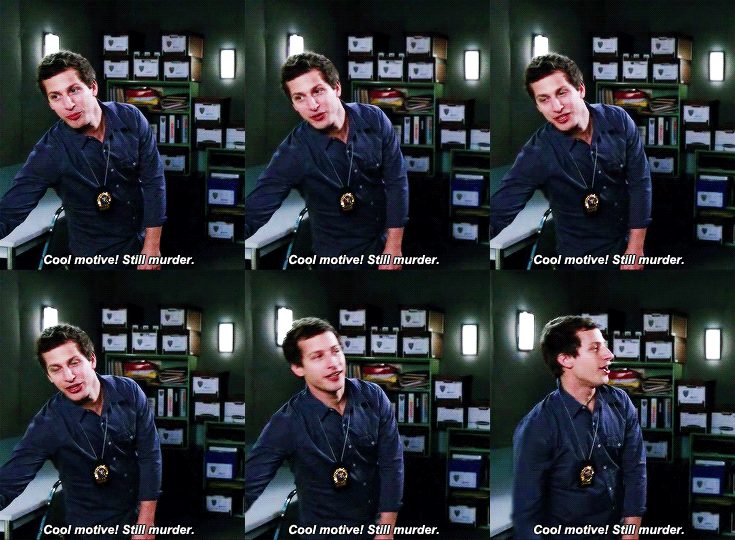
And yet, at the end of the day, Handler’s entire philsophy of how you might not be able to redeem yourself can really be summarized in one gif:
I feel like this stems fundamentally from Handler’s Jewishness as opposed to Rownling’s Christianity. Christians believe we’re all sinners, but we can be saved at any time in life through Jesus (details vary by sect). On the other hand, Jews believe that there ARE things that cannot be forgiven, evil deeds that you cannot be redeemed from after they’ve happened…
Because forgiveness involves being forgiven, and you can’t forgive someone for murdering you (because you’re dead)




 sky's stuff