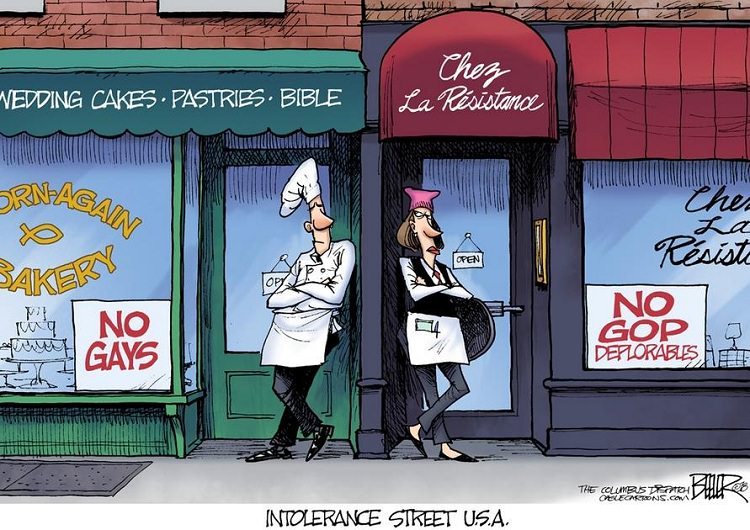
conservatives are intolerant of who you are; progressives are intolerant of what you do. a good cartoon.
Why is that bakery selling “Bible”
Just one Bible? Offered at a totally unrelated business? I’m so confused
I feel bad for OP because they probably just wanted to post their little post and get their handful of notes for it, but this is such a perfect piece of rhetoric to dissect that I’m going to forcibly make it into a teaching tool, and they’re just going to have to deal with that. In this case, OP and the cartoonist are confusing judgment with prejudice. It’s likely to be simple ignorance on OP’s part, but it’s a deliberate rhetorical choice that the cartoonist made to create this piece of propaganda.
OP and the cartoonist are both conflating judgment/prejudice and equating them, stating that they are both equally bad forms of “intolerance”.
Society usually suggests it is fair and reasonable to “judge” people differently based on their behavior choices. This is the underpinning of many institutions, such as education, justice, barter, and (generally) employment. If people behave badly, this rule says, then they are supposed to receive fewer rewards and opportunities, until they correct their bad behavior or are forcibly deprived of their rights.
This judgment is also how many people behave at a personal level, as it allows personal relationships to function, and behavioral choices can be made based on previously agreed rules about what good behavior looks like. This is generally considered to be an acceptable way to run a society; if someone lies, steals, cheats, or attacks others, then they have behaved badly, and the society judges and treats them accordingly. In this manner, society is kept in a relatively stable form. It would be very hard to demolish this system, and I’m not sure what a sustainable alternative would be.
This is why “Judgment” is considered to be logical and reasonable, while “prejudice” (quite literally pre-judgment) is considered to be illogical and unreasonable. That’s why having “good judgement” means being able to make good decisions, while there is no such thing as “good prejudice”. Judgement makes the laws; prejudice, when used to discriminate against people, is often illegal. They are not the same thing.
The idea that bad behavior should
not be tolerated is as old as the Code of Hammurabi. It’s the
foundation of multiple religious texts. It’s what little children are taught from the cradle all around the world, and is the foundation of most Heavens and Hells. It is usually called
something like “judgment”, “justice,” “consequences” or “discipline” …
not “intolerance.” But if it is called intolerance, then it is certainly correct that bad behavior is not supposed to be tolerated.According to the OP and cartoonist, the animal kingdom is surprisingly left-wing, with social animals being particularly intolerant of “what people do” when those actions unfairly deprive others of resources. Chimpanzees and ravens can be taught to play cooperative games by scientists – and, famously, social animals don’t want to play with animals that reveal themselves as cheaters or thieves. Animals that behave unfairly during cooperative games quickly lose the trust of other animals, and their fellows will refuse to play cooperative games with them. To me, as an evolutionary biologist, it’s amazing to think that concepts like “accountability” are meaningful to animals.
If you genuinely believe that this is a bad thing – that intolerance of “what [people] do” is just as bad as intolerance of “what [people] are,” then my goodness! Equating those would be a complete overhaul of the most basic tenets of human society, spirituality and morality. I really would be interested in knowing what the alternative would be, and how a society could be run if it genuinely considered these things to be equal. I would genuinely like to know how far this belief goes when questioned, and how people manage to reconcile it with their position in society.
So what’s the idea behind the rhetoric in the OP? Well, apart from confusing and misinforming people, it hopes to convince them that judgment and prejudice are equally bad. This will be useful because if people believe this, it can be used to convince them that they must not punish social-rule-breakers (“You are obligated to serve customers who behave badly”) as well as diminishing the role of civil rights. The idea that “both sides are equally bad” is a commonly sown one in this decade, as it hopes to create a majority of disillusioned, docile people who won’t vote and don’t believe in change, leaving the playing field to be controlled by energetic extremists.
But in an insidious way, it also attacks that idea of “accountability,” that nebulous nation-building concept that even crows hold dear. Personally, that’s not what I like to see in my opinion leaders – it’s most commonly promoted by people who behave badly.
OP is right about cartoon quintessentially full of shit. Thank you @elodieunderglass for that excellent demonstration of exactly why and how.
ETA edited because I completely misread initially – the OP is the initial comment, not the cartoon!!!!!!
buddy you think you feel bad for OP

 sky's stuff